AZ-104 vs. SAA-C03: One Exam Asks How You’d Run It, The Other Asks What You’d Build
When someone is trying to decide whether to start with Azure or AWS, the choice usually gets boiled down to AZ-104 versus SAA-C03, since they're the two associate-level certs everybody points to first. They sit at the same level, they cost about the same, and they both say "cloud" on the badge, so it's easy to assume they're two versions of the same test.
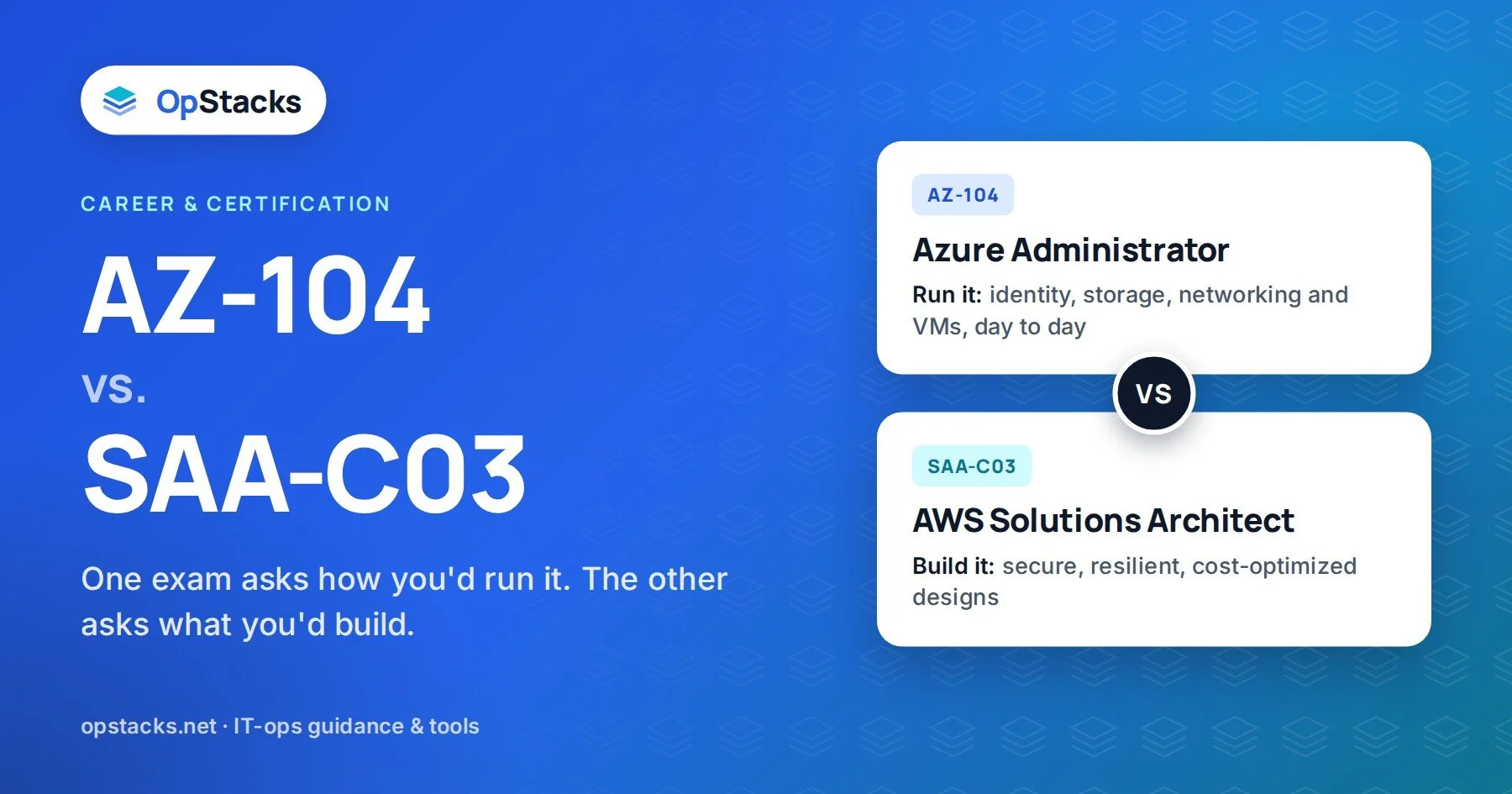
They aren't, and that's the part most people don't find out until they're a few weeks into studying. AZ-104 is an administrator exam, it tests whether you can run identity, storage, networking and VMs day to day. SAA-C03 is an architect exam, it tests whether you can pick the right services for a design and defend the choice. Same level, different job.
If you know which of those two jobs sounds more like you, the first cert usually picks itself. So here's what each exam actually tests, side by side.
The short version
| AZ-104 | SAA-C03 | |
|---|---|---|
| Full name | Microsoft Azure Administrator | AWS Certified Solutions Architect – Associate |
| The job it certifies | The person who builds, runs and fixes the environment | The person who decides what the environment should look like |
| What a question asks | How do you configure this? | Which design meets these requirements? |
| How it's organized | 5 skill areas built around services: identity, storage, compute, networking, monitoring | 4 domains built around design goals: secure, resilient, high-performing, cost-optimized |
| Passing score and time | 700 out of 1,000, 100 minutes | 720 out of 1,000, 130 minutes for 65 questions (50 scored) |
| Exam fee (US) | $165 (varies by country) | $150 |
| Keeping it current | Expires every 12 months, renewed with a free online assessment on Microsoft Learn | Good for 3 years, then pass the current exam again or earn the Professional cert |
The row that matters most is the third one. Everything else, from how you study to how the questions read, follows from it.
What AZ-104 actually tests
Microsoft describes the AZ-104 candidate as someone who implements, manages and monitors an organization's Azure environment, and the skills outline reads like a sysadmin's task list. It expects you to be comfortable with operating systems, networking, servers and virtualization, and to have used PowerShell, the Azure CLI, the portal, ARM templates or Bicep, and Microsoft Entra ID.
| AZ-104 skill area | Weight | Think of it as |
|---|---|---|
| Manage Azure identities and governance | 20–25% | Entra ID, RBAC, Policy, costs |
| Implement and manage storage | 15–20% | Storage accounts, SAS, Files, Blob |
| Deploy and manage Azure compute resources | 20–25% | VMs, Bicep/ARM, containers, App Service |
| Implement and manage virtual networking | 15–20% | VNets, peering, NSGs, DNS, load balancers |
| Monitor and maintain Azure resources | 10–15% | Azure Monitor, Backup, Site Recovery |
Look at the verbs under each area in Microsoft's study guide, they're almost all "create," "configure" and "manage." A few examples straight from the outline:
Identity — assign roles at different scopes and interpret access assignments, configure self-service password reset
Storage — create shared access signature tokens, configure redundancy, set up blob lifecycle management and soft delete
Compute — modify an existing Bicep file, move a VM to another resource group or region, deploy to availability zones
Networking — configure peering and user-defined routes, evaluate effective NSG rules, troubleshoot connectivity
Monitoring — query logs in Azure Monitor, set up alert rules, run a Site Recovery failover
So the questions tend to sound like "a user can't reach this VM, which NSG rule is the problem" or "what do you set on this storage account so old blobs move to the cool tier." You're being asked to do the work, and the fastest way to get good at that is doing it in a real subscription, over and over.
What SAA-C03 actually tests
AWS describes the SAA-C03 candidate as someone with at least a year of hands-on experience designing cloud solutions, and the whole exam is organized around the AWS Well-Architected Framework. Notice that none of the four domains are named after a service, they're named after a design goal.
| SAA-C03 domain | Weight | Think of it as |
|---|---|---|
| Design Secure Architectures | 30% | IAM, encryption, network controls |
| Design Resilient Architectures | 26% | Multi-AZ, decoupling, recovery |
| Design High-Performing Architectures | 24% | Right storage, compute, database |
| Design Cost-Optimized Architectures | 20% | Pricing models, storage classes, sizing |
A typical SAA-C03 question gives you a short business scenario, a company with an app, some traffic pattern and a requirement or two, then asks which solution meets those requirements. The tricky part is that two or three of the answers usually work. The exam wants the one that fits the constraint in the question, and the constraint is often a single word like "most cost-effective," "least operational overhead" or "highly available."
That's a different skill than configuration. You don't need to know which button to click in the console nearly as much as you need to know when S3 beats EFS, when SQS beats a direct call, or when a Multi-AZ database is worth the cost. AWS says outright that the exam doesn't require deep coding expertise, however it does expect you to know the trade-offs across a lot of services.
Admin or designer: which one sounds like your week?
Forget which cloud is "better" for a minute and think about the work you like doing, because that's what you'll be studying for the next couple of months.
AZ-104 is probably your first cert if — you're the person who builds the server, fixes the permissions and gets paged when the backup fails. It also fits if you already live in Active Directory, Microsoft 365 or Windows Server, since a lot of that knowledge carries straight into Entra ID, RBAC and Azure networking
SAA-C03 is probably your first cert if — you're the person in the meeting drawing boxes on the whiteboard, you like weighing options more than executing them, or your target jobs are in shops that already run on AWS
Either one works if — you're coming from help desk or another field entirely. In that case, look at the job postings in your area and let the platform they ask for decide it
Neither choice is permanent. Plenty of people pass one and pick up the other within a year, and the second one goes faster because the core ideas, identity, networking, storage and redundancy, carry over.
Study each one the way it's tested
This is where the difference really shows up. If you study for SAA-C03 like an admin exam, you'll know a lot of settings and still miss the scenario questions. If you study for AZ-104 like an architect exam, you'll understand the concepts and then freeze on a question about which blade in the portal to use. That's the reason I built the OpStacks study planners separately for each exam instead of making one generic cloud planner.
Both planners use the same 8-page layout, however what you do with each page is different depending on the exam:
Exam-at-a-glance page — the official domains and weights on one sheet, so you can see where the points are before you plan a single study session. For AZ-104 that means identity and compute get the most time, for SAA-C03 it means security gets the most
Skills mastery checklist — every objective from the official outline, broken out so you can check them off as you go. For AZ-104 that's your lab list, you don't check it off until you've done it in a subscription. For SAA-C03, check it off when you can explain why you'd pick that service over the alternatives
Weekly and daily study logs — plan the week, then write down what you actually did each day. For AZ-104, log your lab time and what broke. For SAA-C03, log the service comparisons and scenarios you worked through
Practice-test tracker — record every practice exam score so you can see where you're trending and which areas keep costing you points. This matters a lot on SAA-C03, where the scenario questions will expose a weak domain fast
Each planner comes in two color styles, Clean and Bold, in both US Letter and A4, with a one-page Start Here guide for getting set up. They're printable PDFs, so you can print the whole thing or just the weekly logs, and they're $12.99 each in the OpStacks shop on Etsy.
Your first week, either exam
Whichever way you're leaning, the first week looks about the same:
Read the official outline once, start to finish. Microsoft's AZ-104 study guide and AWS's SAA-C03 exam guide are both free and they tell you exactly what's in scope.
Fill in the exam-at-a-glance page and pick a test date. A date on the calendar changes how seriously the rest of the plan gets taken.
Take a baseline practice test before you study anything. Microsoft offers a free AZ-104 practice assessment on Microsoft Learn. Log the score in the tracker even if it's rough, that's the point.
Map your weak areas onto the weekly log. Put the heaviest-weighted areas you scored worst on in the first few weeks.
Set up your hands-on environment. An Azure free account for AZ-104 or an AWS Free Tier account for SAA-C03, with a budget alert set on day one so a forgotten VM doesn't turn into a bill.
If you're still on the fence between the two, or you're trying to figure out which one fits the job you're going after, let me know at opstacks@outlook.com and I'll give you my take.